
EUROPE
Balancing Minimalism with Operational Utility
Clean-tech & Industrial IoTDashboard
THE PROBLEM
Paradox of Minimalist Industrial Design
A cleantech startup built a platform that combines HaaS and SaaS into a single integrated offering. The original design leaned into a bold 'neo-brutalist meets Nordic minimalism' aesthetic — high-contrast dark navigation paired with a warm, cream-toned workspace. Visually striking. But in industrial energy SaaS, good looks don't earn a seat at the table unless they earn it.
Operators manage hundreds of live data points across HVAC systems, sub-metering, and volatile spot pricing. The original UI, for all its visual confidence, was making them work harder than it should. Labels were ambiguous. Data hierarchies weren't obvious. Critical alerts competed with ambient interface elements for attention.
The instinct in design is often to strip back. But minimalism applied to a complex operational dashboard isn't restraint, it's avoidance. So the goal wasn't to simplify further. It was to discipline the design, and in places, add back what had been stripped out in the name of aesthetics: clearer hierarchies, explicit labelling on critical controls, stronger contrast on actionable elements.
THE DIAGNOSTICS
Uncovering the UX Friction Points
While the layout architecture is beautiful and possessed a strong structural skeleton, a deep-dive UX analysis of the existing "Consumption" dashboard revealed three critical areas where visual minimalism created cognitive friction:
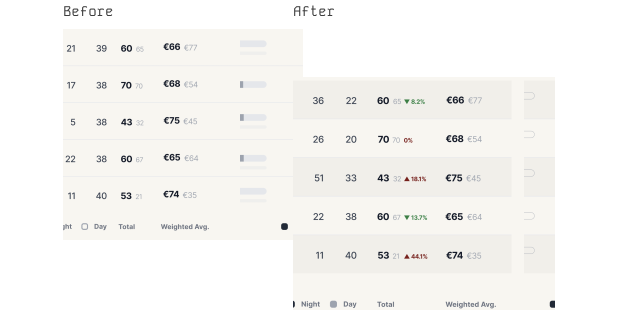
1. **Comparison overload:** With the Compare Periods toggle active, the data table placed two raw numbers side-by-side with no sub-headers distinguishing Current from Previous. No calculated delta meant facility managers were doing mental math on the fly to determine whether a zone was underperforming.
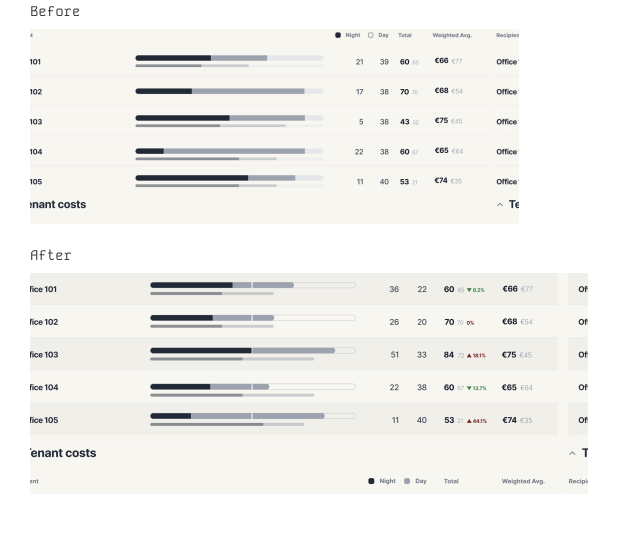
2. **Ambiguous visualisation:** The horizontal bars representing Night vs. Day energy usage per tenant office had no grid, scale, or percentage markers. It wasn't clear whether bars represented a percentage of 100% or absolute variable values. This resulted in the dashboard raising questions instead of answering them.
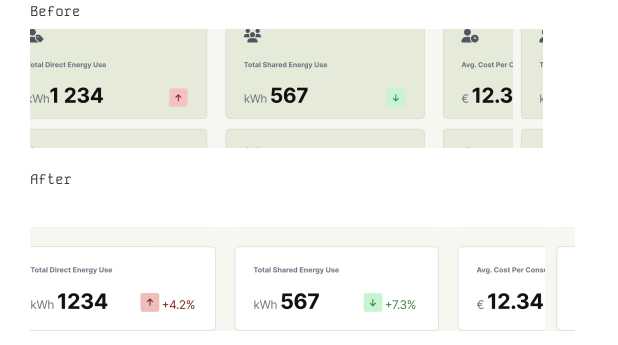
3. **Colour-reliant KPI cards:** The macro KPI summary cards used colour alone to communicate consumption trends, an immediate accessibility blocker for colour-blind operators. Worse, an Up arrow in energy management signals costly waste (the opposite of what it means in standard SaaS convention) with no contextual copy to resolve the ambiguity.
THE SOLUTION
3 Low-Effort, High-Impact Improvements
We introduced three targeted design refinements designed to maximize operational speed for engineers while delivering immediate "board-ready" visual proof of ROI for the CFO.
IMPROVEMENT 1 — Redesigned Comparison Architecture
Current period data stays prominent, paired with a clear delta badge — 60 ▲ 8% or €66 ▼ 12% — so operators see velocity and direction instantly. No mental math.
IMPROVEMENT 2 — Axis-anchored stacked bars
Ambiguous horizontal lines became structured 0–100% stacked percentage bars with a 50% midpoint guide. Asset managers can immediately see which tenants are drawing expensive peak Day energy versus lower-cost Night energy.
IMPROVEMENT 3 — Accessibility fix
KPI cards now pair colour shifts with explicit text labels like +4.2% vs last month, keeping the interface legible for colour-blind operators. On wide factory-floor monitors, alternating row shading helps engineers scan horizontally across dense data without losing their place.
THE RESULT
Highly usable and fully accessible
By refining how high-density consumption data is visualised, the redesign closes the ROI translation gap between the boiler room and the boardroom.
Facility managers can now spot anomalies in seconds rather than exporting data to run manual Excel equations. And when the CFO logs in, the platform immediately communicates a clear financial narrative: technical efficiency gains translated into avoided costs, adjusted for market volatility, without digging through a single report.
The result is a system that earns its place at both ends of the organisation. Highly usable, fully accessible, and directly tied to software adoption and contract renewals.